
100% toxic-free plant support
It sounds logical to produce plant sticks from plant residues. But unfortunately it is not yet for one billion plants a year.
Together with you, Kratiste wants to sustainably produce 1,000,000,0000 plant poles a year! A small effort for you – big impact on the world!
Free of volatile substances
– Approved for volatiles according to EN 13432 (2000), ASTM D6400 (2023), CAN/BNQ 0017-088 (2010) and ISO 18606 (2013).
Free of heavy metals
Approved for heavy metals according to EN 13432 (2000), ASTM D6400 (2023) and CAN/BNQ 0017-088 (2010).
Free of fluorine
Approved for fluorine according to EN 13432 (2000).
Proven compostable and free of harmful substances
Independently tested

Start - Kratiste's climbing stick is ground to 5 cm (2 inches) by 5 cm (2 inches). This is standard practice for garden waste.

Week 1 - cut pieces of 5 centimeters x 5 centimeters.

Week 2 - the samples are already getting a little softer.

Week 3 - samples begin to dissolve as compost.

Week 4 - sample sizes have already decreased almost 50%.

Week 6 - the bacteria continue to eat the samples and digest them completely.

Week 8 - only 20% of the original size remains.

Week 10 - The largest samples are only a fraction of the original.

Week 12 - the bacteria have converted the Kratiste climbing vine into 100% safe compost. You can grow new plants on this again!
From plant scraps, to climbing stick and back to plant scraps. This is how sustainability works.
Use the power of nature
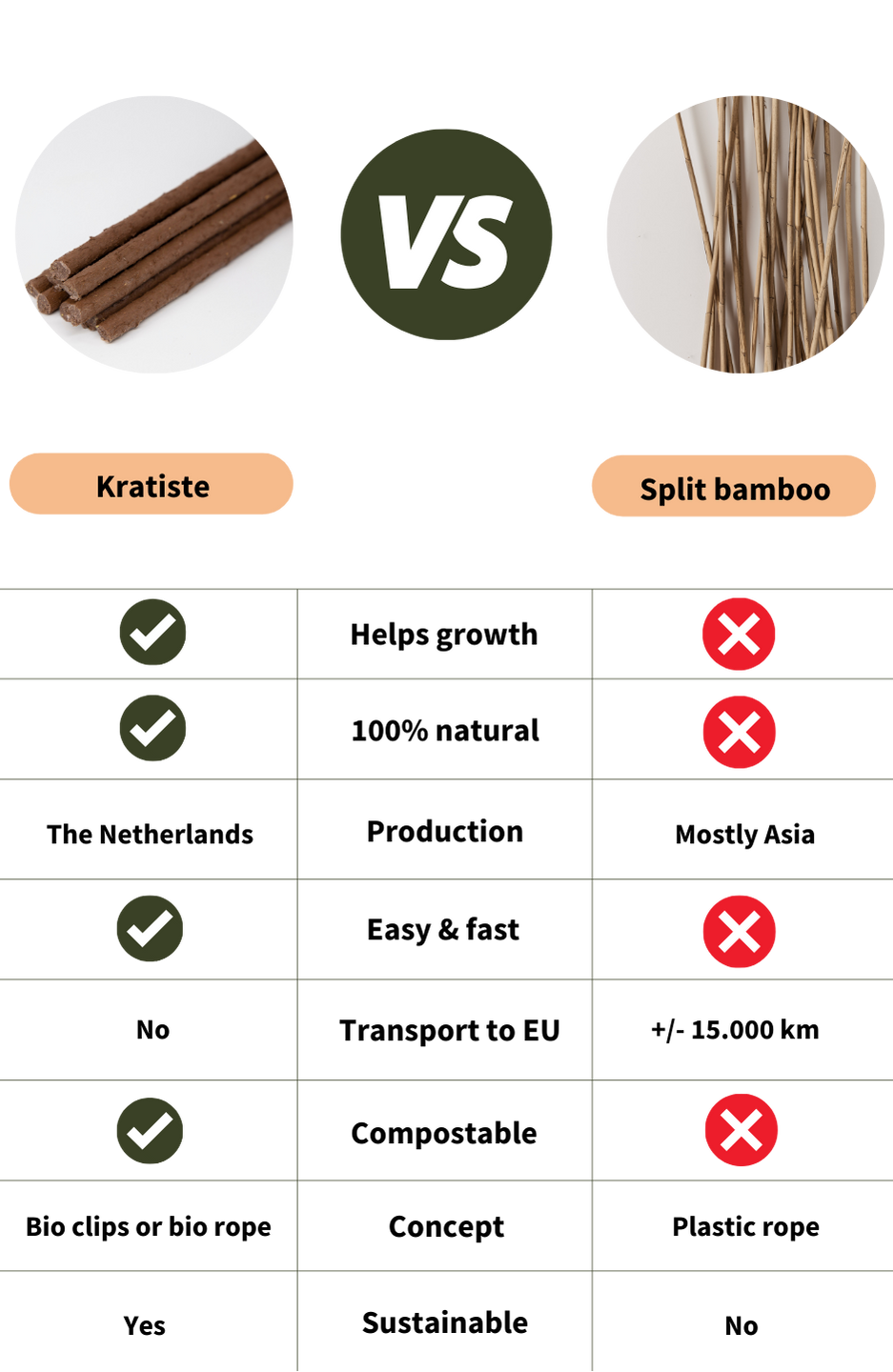
Compare directly

Micro-plastics and harmful substances
The truth behind your plant stick
I thought my plant canes were natural. Why are they not?
Your plant grows in a warm, humid greenhouse – ideal for growth, but also for mold. Plant canes in these conditions quickly go moldy unless they are treated with chemicals or covered with plastic. But let’s face it: no one is waiting for a “sustainable” plant cane that is covered in mold.
What harmful substances are often found in plant canes
There are several substances that can slow mold growth – think prussic acid or cadmium. But let’s face it: these are not substances you want near your plants or in nature. That is why it is essential to choose plant sticks that are safe – for you and for the environment.
Many canes are also plastic-coated. Just take a stick out of an orchid: you can see that the coating stops exactly at the edge of the potting soil. That same coating eventually ends up in the compost and is crushed along with it. And that, of course, has its consequences – for the earth and the cycle.
Why didn't I know this?
For more than 30 years, there was no real alternative to noxious plant canes. Why? Because developing a sustainable alternative is incredibly complex.
After all, a plant stem not only has to last up to 12 months in a warm, humid greenhouse – it also has to be able to compost well afterwards when the consumer throws it away with the plant waste. And all under practically the same conditions. Not an easy task.
How do plant canes compost?
Moisture, heat and bacteria – that’s the challenge. In a greenhouse, humidity rises above 95%, temperatures can rise above 55°C, and bacteria are plentiful. These are exactly the conditions in which a plant stem must continue to function … AND in which it must also later degrade when discarded.
That combination makes developing 100% natural plant support particularly complex. But after five years of intensive development, Kratiste has succeeded.
Is your story true then?
We leave nothing to chance. That is why we have had our products independently tested by Normec OWS – Europe’s leading laboratory for compostability and biodegradability. This way we can be sure that our plant canes do what they promise: strong in the greenhouse, safe in nature.
The scale of cratering
Growing numbers
%
Our raw materials are 100% natural. Also, the products are fully compostable. This has been independently determined by OWS-Normec.
Just under one billion canes are yet to be made sustainable. Together with sustainable retailers, we are making better products for consumers and the world!
Over 75 tons of plastic from traditional moss sticks as well as coated bamboo did not end up in the compost pile.